
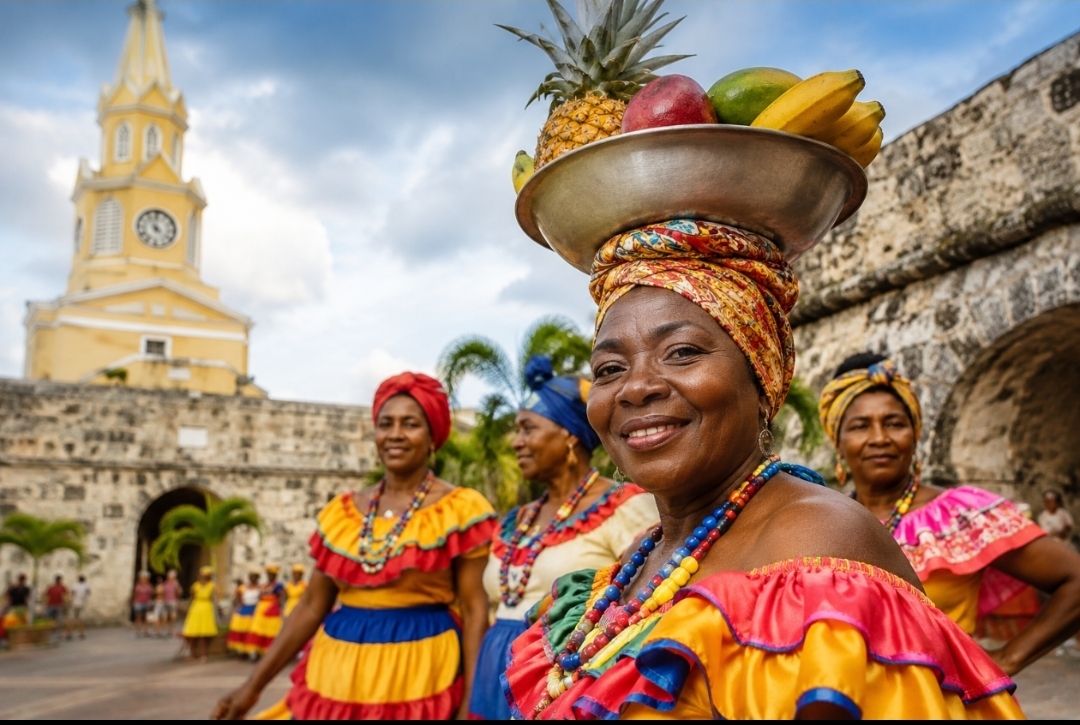
When people think about the historical relationship between Colombia and Africa, many immediately associate it with the transatlantic slave trade. However, few realize that one of the most influential African civilizations in Colombian history was the Kingdom of Kongo, a powerful Central African state that existed for more than five centuries and whose cultural legacy continues to shape Colombian society today.
The connection between Colombia and the regions of present-day Democratic Republic of the Congo, Republic of the Congo, and Angola is not a recent diplomatic relationship. It is a story that spans more than 500 years and includes kingdoms, trade networks, resistance movements, spirituality, language, music, and cultural survival.
The history of Afro-Colombian communities cannot be fully understood without understanding the Kingdom of Kongo and the people who crossed the Atlantic under tragic circumstances but carried with them knowledge, traditions, beliefs, and resilience that would forever transform the Americas.
The Kingdom of Kongo: One of Africa's Great Civilizations
Long before European colonization, Central Africa was home to sophisticated kingdoms and political systems. Among the most influential was the Kingdom of Kongo, founded around 1390.
The kingdom stretched across vast territories that today form the Democratic Republic of the Congo, the Republic of the Congo, Angola, and parts of Gabon. Its capital, Mbanza Kongo, was one of Africa's most important urban centers.
The Kingdom of Kongo was governed by the Manikongo, the king elected by leading nobles known as Bambuta. The kingdom maintained a structured political administration, regional governors, taxation systems, diplomatic relations, military forces, and extensive trade networks.
At its height, Kongo was one of the most powerful states in Central Africa. European explorers who arrived in the fifteenth century were often surprised by the kingdom's sophistication, organization, and wealth.
The Arrival of Europeans and the Beginning of a Tragic Era
In 1482, Portuguese navigator Diogo Cão reached the mouth of the Congo River and established contact with the Kingdom of Kongo. Initially, relations between Portugal and Kongo were diplomatic and commercial. The Kongo monarchy exchanged ambassadors with Portugal, embraced aspects of Christianity, and participated in international trade.
However, these relations gradually evolved into something far darker. As European demand for labor increased in the Americas, Central Africa became one of the principal sources of enslaved people. Over the following centuries, millions of Africans were captured, sold, and transported across the Atlantic Ocean. Among them were thousands of people from Kongo territories.
Cartagena de Indias: The Gateway to Spanish America
The majority of enslaved Central Africans arriving in Spanish South America passed through the port city of Cartagena de Indias in present-day Colombia. Cartagena became one of the largest slave-trading centers in the Americas. Ships carrying captives from the Congo Basin, Angola, and neighboring regions arrived regularly at the city's docks.
The people who disembarked in Cartagena brought with them languages, religious beliefs, agricultural knowledge, medical traditions, music and rhythms, social structures, and spiritual philosophies. Although enslavers attempted to erase their identities, many Congolese traditions survived. These traditions became deeply rooted in Colombian society.
Resistance and the Birth of Free Communities
Many enslaved Africans resisted captivity. Some escaped plantations and colonial settlements and established independent communities known as Palenques. The most famous of these communities was San Basilio de Palenque.
Founded by escaped enslaved Africans during the seventeenth century, it became one of the first free African towns in the Americas. The residents of Palenque preserved many cultural practices inherited from their ancestors. Today, scholars identify numerous linguistic and cultural elements linked to Central African traditions, particularly those originating from Kongo-speaking populations.
San Basilio de Palenque remains one of the most important symbols of African resistance and cultural survival in the Western Hemisphere.
Kongo Spirituality Across the Atlantic
The Kingdom of Kongo possessed a rich spiritual tradition long before European contact. Central concepts included reverence for ancestors, sacred cosmological symbols, healing traditions, community responsibility, respect for nature and rivers, and the interconnectedness of the spiritual and physical worlds.
Many of these beliefs survived in secret among enslaved populations. Across Latin America, Kongo spiritual influences contributed to the development of religious and cultural traditions that can still be observed today in Colombia, Cuba, Brazil, Haiti, and Venezuela.
The famous Kongo cosmogram, a sacred symbol representing life, death, rebirth, and spiritual continuity, continues to be studied by historians and anthropologists as one of Africa's most enduring contributions to the Americas.
Language and Cultural Memory
One of the most remarkable examples of African cultural survival is language. The language spoken in San Basilio de Palenque contains influences from Spanish as well as African linguistic structures. Researchers have identified strong connections to Bantu language families, including those spoken in historical Kongo territories.
Words, expressions, rhythms of speech, and oral storytelling traditions all reflect African origins. These linguistic traces serve as living evidence of the historical connection between Colombia and Central Africa.
Music, Dance, and the Rhythm of the Congo
Perhaps nowhere is the Kongo legacy more visible than in music. African drumming traditions survived despite colonial attempts to suppress them. Today, many Afro-Colombian musical forms contain rhythms and structures rooted in Central African traditions.
Traditional instruments, call-and-response singing styles, collective dancing, and ceremonial performances all reflect elements brought across the Atlantic by enslaved Africans. The drum became more than a musical instrument. It became a tool of memory, resistance, communication, and identity.
For many Afro-Colombian communities, music remains a bridge connecting the present to ancestral African heritage.
The Economic Power of the Ancient Kongo Kingdom
The Kingdom of Kongo was not merely a political state. It was also an economic powerhouse. The confederation known as Kongo dia Nlaza became renowned for textile production. Historical records describe large-scale manufacturing of raffia cloth and palm-fiber fabrics. These textiles were traded throughout Central Africa and exported to Portuguese territories. Some records indicate annual exports reaching approximately 100,000 meters of cloth.
This level of production demonstrates that Central Africa possessed advanced industries long before colonial rule. Understanding this history challenges outdated stereotypes and highlights the sophistication of African civilizations before European domination.
The Fall of the Kingdom of Kongo
The Kingdom of Kongo survived for more than five hundred years. However, internal conflicts, foreign interference, the slave trade, and colonial expansion gradually weakened the kingdom. Following the Kongo Civil War between 1665 and 1709, political instability increased.
Portuguese influence continued to expand throughout the nineteenth century. In 1888, the last sovereign signed agreements that further reduced Kongo independence. Following the 1913–1914 revolts, Portuguese authorities abolished the title of King of Kongo. After more than five centuries, one of Africa's greatest kingdoms formally disappeared. Yet its culture survived.
Modern Connections Between Colombia and the Democratic Republic of the Congo
Today, the relationship between Colombia and the Democratic Republic of the Congo extends beyond history. Both countries participate in international organizations and maintain diplomatic relations. Researchers, historians, cultural organizations, and Afro-descendant communities increasingly explore the historical links connecting Central Africa and Latin America.
Many Afro-Colombians are now seeking deeper understanding of their ancestral roots. Likewise, growing interest exists within the Congo region regarding the global influence of Kongo civilization and its descendants. These efforts are helping reconnect communities separated by centuries of history.
Why does the Kongo–Colombia connection matter today?
The story of Colombia and the Kingdom of Kongo is not simply a story of slavery. It is a story of civilization, resilience, resistance, survival, and cultural endurance. Despite unimaginable suffering, the descendants of Kongo peoples preserved languages, music, spirituality, traditions, and knowledge that continue to enrich Colombian society.
Their legacy can be heard in songs, seen in dances, felt in community traditions, and observed in cultural practices throughout Colombia. Understanding this shared history allows both Colombians and Congolese people to appreciate the depth of their historical connection and the extraordinary journey that links the Congo Basin to the Caribbean coast of South America.
More than four centuries after the first ships crossed the Atlantic, the cultural heartbeat of the Kingdom of Kongo continues to echo across Colombia. It remains one of the most powerful examples of African influence in the modern world.